
This episode is real people designed and AI narrated.
With the rise of AI through ChatGPT, many educators are still worth teaching now that AI is here?
Our stance is clear: NO!…but programming is!
To give a bit of context, we make a clear distinction between coding and programming. In a nutshell: coding is to programming what writing is to authoring a book. Writing (coding) is an essential part, but authoring a book (programming) involves much more: planning the plot, developing characters, editing, and publishing. In short, coding is the part of programming that focuses on writing lines of code (instructions) for the computer.
With the rise of AI, the keyboard might not be as essential anymore. Instead, more natural, human-centered ways of communicating with machines are being adopted in classrooms: speech/voice, drawing/sketch, or gesture/movement.
While the technical skill of typing code may become less central, there's a wealth of benefits to teaching programming concepts. A few of them include:
We know that coding (the technical syntax) is becoming less important because of AI. But programming — the architecture of computational thinking — is growing in importance. The question for educators is: How do we teach this architecture effectively, especially as non-tech savvy?
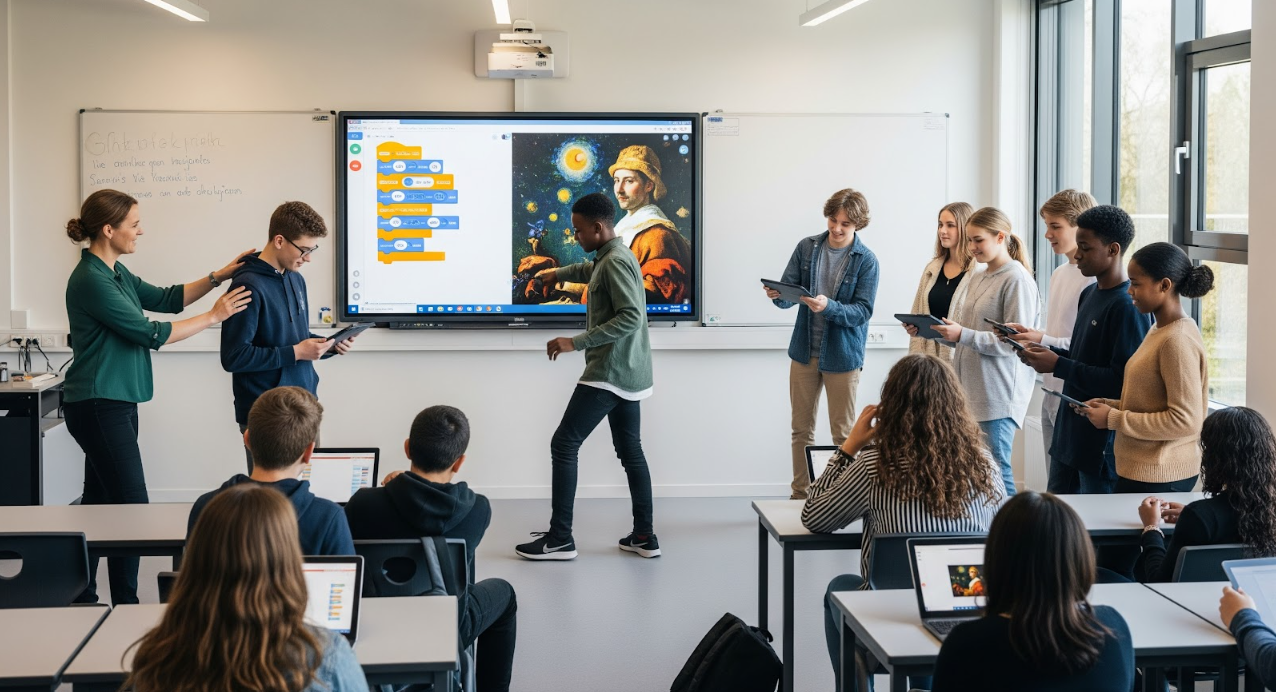
Research from Stanford [ 1 ] suggests that creativity is triggered by movement, not sitting. When we ask students to use "Dance Logic", our approach to teaching programming concepts through choreographed movement, we aren't just making learning fun; we're activating the prefrontal cortex in ways a keyboard cannot.
By shifting from syntax-focused coding to embodied logic, we address two critical needs: we protect students from the cognitive and physical decline associated with sedentary screen time, and we develop the 21st-century meta-skills (like complex problem-solving, collaboration, and creative thinking that AI can't replace.
As educators and school leaders, our responsibility is to provide students with learning approaches that are both effective and healthy. We believe learning technology should never come at the expense of students' mental and physical wellbeing.