
This episode is real people designed, and AI narrated.
We often treat "Physical Education" and "Computer Science" as opposite ends of the school building. One is for the body; the other is for the brain.
But what if this separation is actually limiting how your students learn?
At Body.Scratch, we don't ask students to dance because it's a fun break from coding. We do it because neuroscience shows us something remarkable: choreography and programming share the same cognitive architecture.
Here's the science behind why we ask your students to "Move to Create."
Research into how choreographers think reveals something fascinating [2]. Building a dance routine requires the exact same pattern recognition and problem-solving skills as writing software. When a choreographer plans a sequence of movements, they're essentially programming: they're creating loops, establishing conditionals, and debugging their "code" through their body.
This isn't just a clever analogy. Studies on acute physical activity demonstrate that movement primes the prefrontal cortex — the part of the brain responsible for executive function and logical thinking [3]. By engaging in creative mind-body coordination, students aren't distracted from learning code; they're biologically optimized to understand it.
When a student struggles to grasp what a "loop" does in Python, staring at a screen often leads to frustration. But when they physically perform that loop with their body (repeating a dance sequence until a condition is met) something clicks. They debug the logic through movement [1]. As we say: "Be the concept, my friend."
You might be familiar with physical computing, that is using tangible objects to teach programming concepts. Body.coding takes this further by adding something essential: expressivity.
Research suggests that children naturally use gestures to explain functional concepts before they can articulate them in code [4]. By allowing students to use expressive movement to represent variables, loops, and conditionals, we bridge the gap between abstract syntax and concrete understanding.
This is where Body.Scratch becomes different. We're not just making coding physical. We're making it more human. Students aren't feeding inputs into a machine; they're embodying computational thinking through creative expression [1].

The benefits extend beyond just "getting" programming concepts:
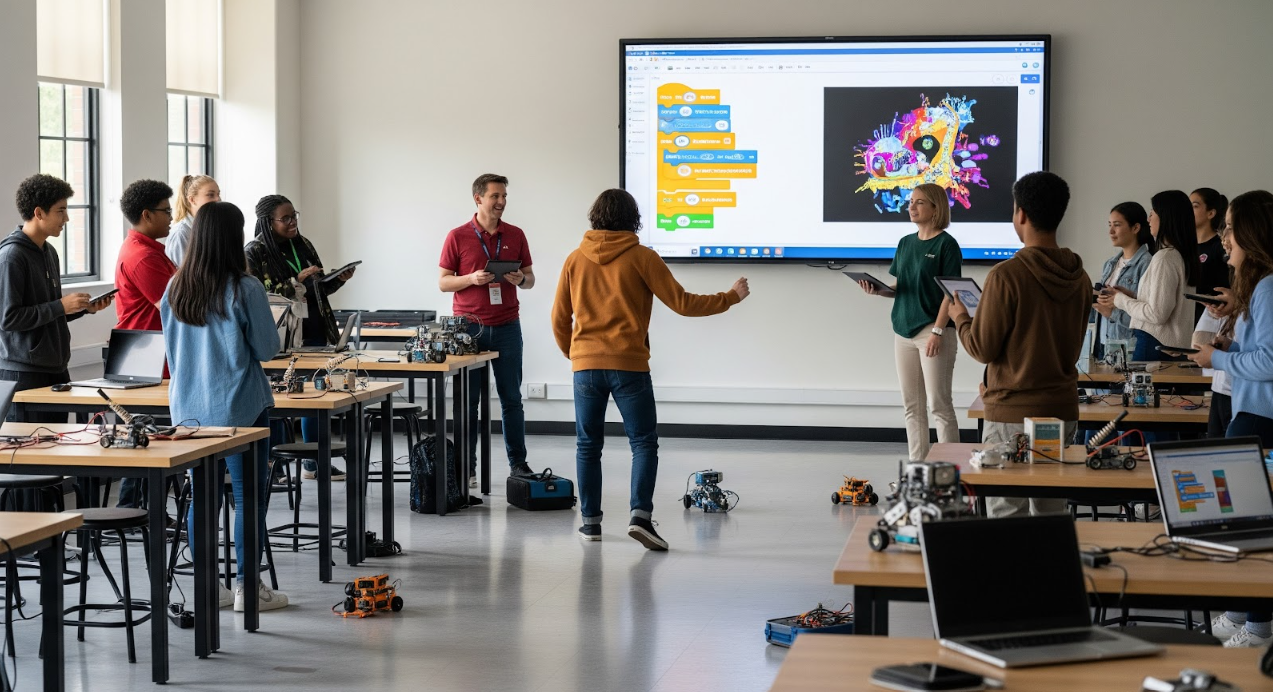
We're moving away from the passive screen time that can numb young minds, toward an approach where students look at each other, not just the monitor. Where the body isn't just a vessel for the brain, it's part of the processor.
We invite you to experience how this works firsthand. Try out our Free Kickstart Plan and see your students discover that learning programming can be active, collaborative, and genuinely joyful.
References
[1] Mikkonen, J. (2019). Bodygramming. Embodying the computational behaviour as a collective effort.
[2] Kirsh, D. (2011). Creative Cognition in Choreography.
[3] Hillman, C.H., Pontifex, M.B., Raine, L.B., Castelli, D.M., Hall, E.E., & Kramer, A.F. (2009). The effect of acute treadmill walking on cognitive control and academic achievement in preadolescent children.
[4] Manches, A., & O'Malley, C. (2012). Tangibles for learning: a representational analysis of physical manipulation.